
New requirements for the classification, monitoring, and provision of master securities data – and how Grand Central supports integration into existing applications.
More Competition – and New Tasks Behind the Scenes
With the launch of the state-subsidized pension savings depot (Altersvorsorgedepot) on January 1, 2027, the market for private pension provision is changing. Banks, online brokers, and digital providers can develop new pension products and build long-term customer relationships. In addition to questions surrounding subsidies, product selection, and terms, there is a significant need for adaptation in specialist processes and IT.
Before a security can be offered or held in a subsidized depot, it must be verified against applicable requirements to determine whether and under what conditions it qualifies for the respective product. This assessment is not a one-time task: key instrument characteristics can change over time.
From Product Selection to Ongoing Monitoring
For financial institutions, this results in several interconnected tasks:
- Building an investment universe: Identifying relevant instruments and selecting them based on defined criteria.
- Categorizing product characteristics: Accounting for investment type, risk class, and other features specific to the use case.
- Tracking changes: Utilizing up-to-date data and historical validity periods for ongoing monitoring.
- Feeding business applications: Providing required information for advisory, product management, regulatory processes, and reporting.
The professional decision on whether an instrument is permissible within a specific client or product context, and whether action is required, remains with the respective institution and its business applications.
New Selection Data from WM Datenservice
In Customer Information K20 dated October 6, 2026, WM Datenservice described the “Selection Data – Pension Scheme” (Selektionsdaten – Altersvorsorge / SEL-A). The data offering includes new indicators for assigning financial instruments to legally specified investment types. In addition, historical information and supplementary master securities data are provided.
Features described in K20 include assignment to the pension savings depot (GD665C), assignment to standard depot investment types by risk class (GD665D and GD665E), their histories (GV9X6 to GV9X8), and information on Value-at-Risk equivalent volatility (GV9X9). Supplementary data includes ISIN, instrument type, product group, risk indicator, and distribution authorization.
The historical assignment is particularly relevant: it makes it possible not only to view the current status of an instrument, but also to identify the timeframe in which an indicator applied. According to WM, daily provision on trading days is planned; the go-live for SEL-A is announced for October 29, 2026.
Important to note: The indicators are derived rule-based from available WM data. Missing information can lead to a fundamentally suitable instrument not being flagged. This does not replace an independent, institution-level business and regulatory assessment.
Practical Example: Building and Maintaining an Investment Universe
For instance, an institution might first build an investment universe for the pension savings depot. Grand Central provides the relevant WM data and selection criteria. On this basis, business applications can check which instruments should be included in the respective offering. If key characteristics of an instrument change later, the updated information can be pushed back to connected systems and used for monitoring, evaluation, or reporting.
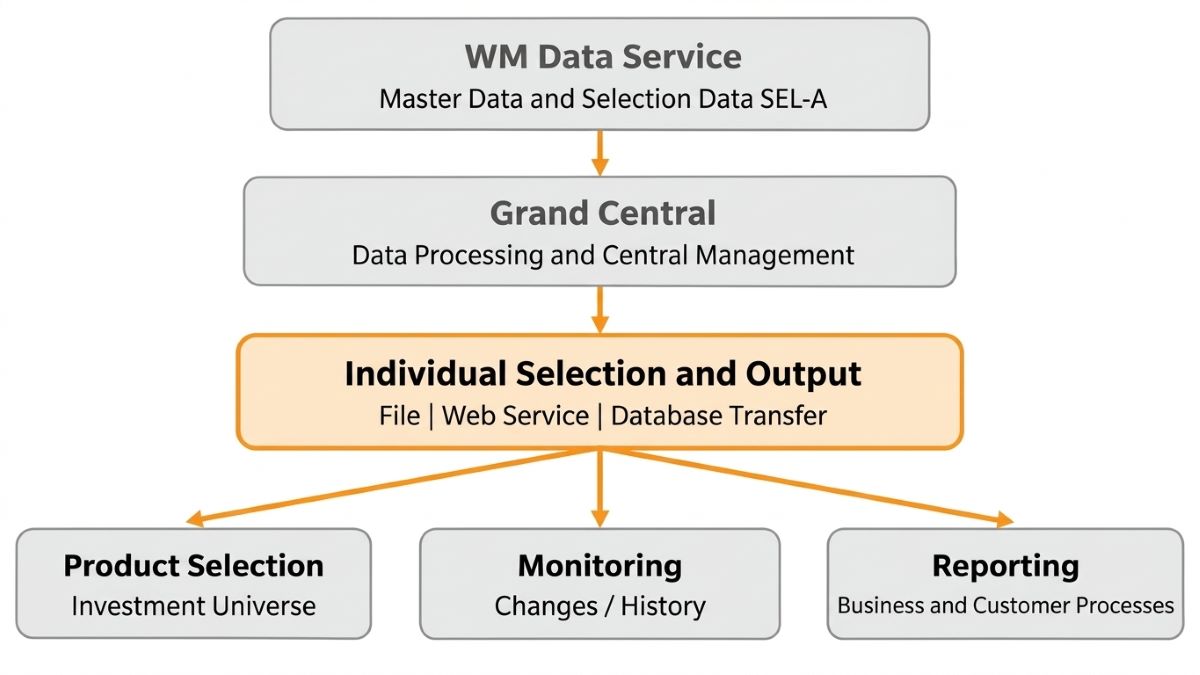
Schematic data flow – business verification and any follow-up actions take place in the respective application systems.
A Single Data Basis for Diverse Processes
A key advantage is that data no longer needs to be processed multiple times and independently for different purposes. An institution can use the same data basis to select instruments, monitor relevant changes, and supply information to various departments. Selection criteria, output formats, and delivery channels can be tailored to specific needs.
The pension savings depot serves as a clear example of a broader trend: new regulatory requirements create additional data demands. Those who can make existing master securities data flexibly available do not need to build a new, isolated data pipeline every single time.
Conclusion: New Requirements, Existing Infrastructure
Implementing the pension savings depot is not just about the product offering itself. The selection, updating, and distribution of relevant securities data must also work reliably. The new selection data from WM Datenservice creates an expanded functional foundation for this.
Grand Central makes it possible to process this data together with existing WM datasets and seamlessly integrate it into institutions’ IT landscapes as needed. This allows the implementation of new data requirements to build directly on existing interfaces and processes.
Do you want to integrate data delivery for the pension savings depot into your applications? Get in touch with us to discuss a tailored selection and delivery option for WM data.
Sources and Further Information
- WM Datenservice, Customer Information K20 dated Oct 6, 2026: “Reform der geförderten privaten Altersvorsorge … – neues Produkt Selektionsdaten (SEL)”, especially pp. 1–7 and 12 (Customer Information; observe usage restrictions).
- Federal Ministry of Finance, “Fragen und Antworten zur Reform der geförderten privaten Altersvorsorge” (May 5, 2026): https://www.bundesfinanzministerium.de/Content/DE/FAQ/reform-der-privaten-altersvorsorge.html
- PwC Germany, “Altersvorsorge 2.0 – Von der Strategie zur Umsetzung” (Mar 26, 2026): https://blogs.pwc.de/de/fs-consulting/article/253828/
